
Folio
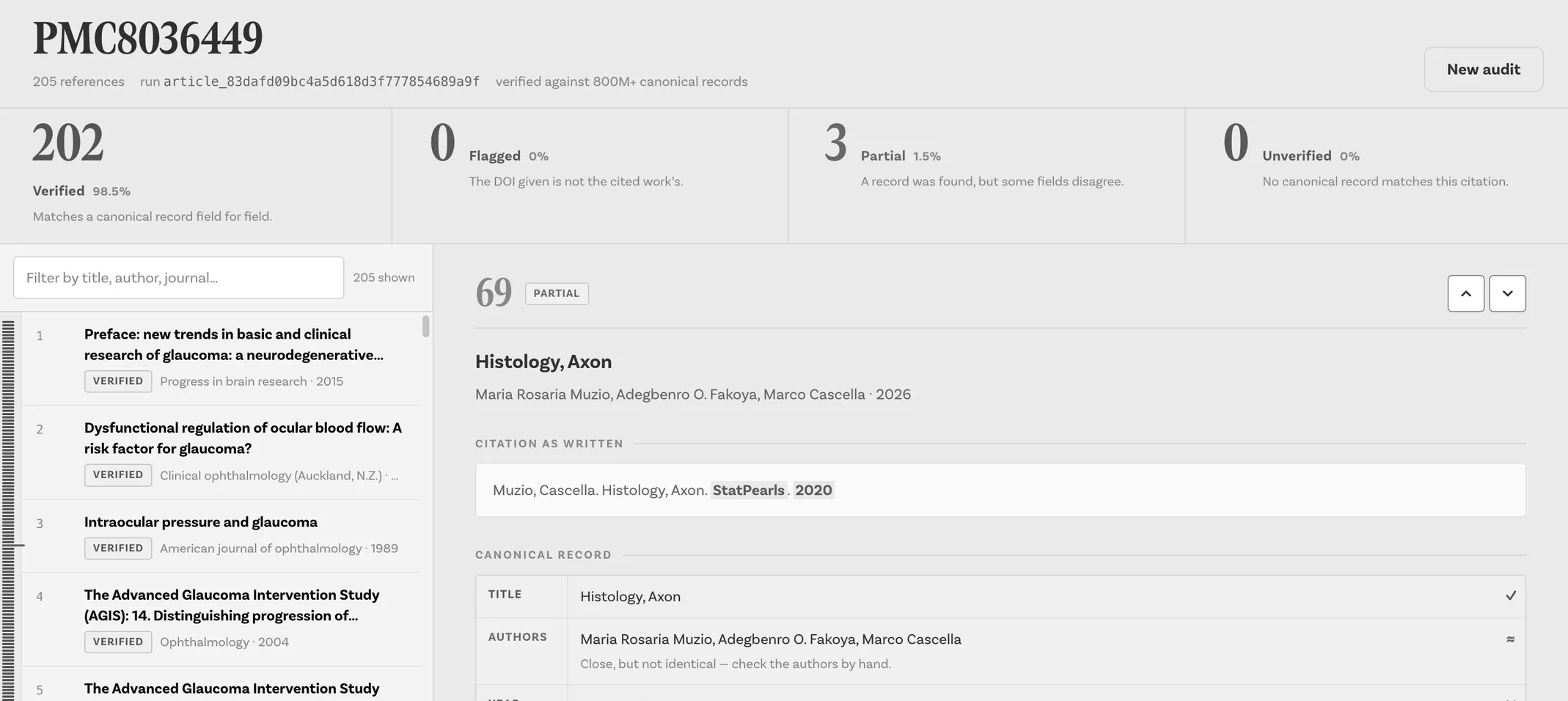
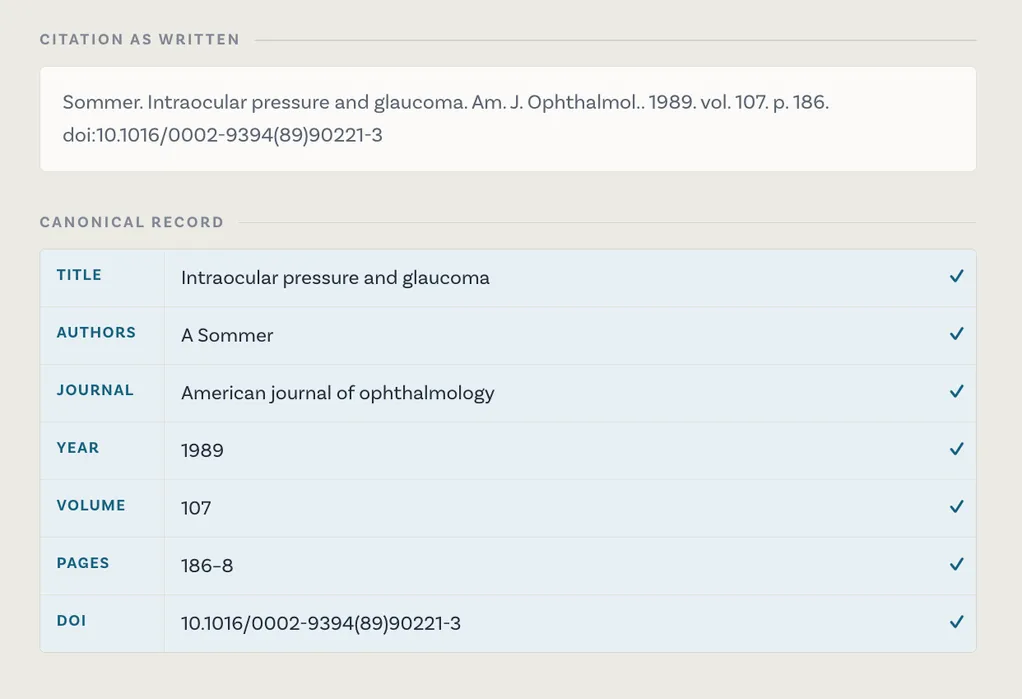
Folio verifies every reference in a published scientific article against more than 800 million canonical source records. Every reference is checked field by field — title, authors, journal, volume, year, pages, DOI.
- 800M+Canonical source records
- 7Citation error types identified and classified
- 1-3 minTypical audit time for a full published article
- 0AI in the verification pipeline
Science has a reference problem.
Fabricated and distorted citations now appear in journals across every discipline. They are correctly formatted, attributed to real researchers, and invisible to conventional peer review.
110,000+
Estimated 2025 publications containing invalid references — a rough extrapolation by Nature from 65 confirmed cases in a sample of about 4,000 publications.
Naddaf & Quill, “Hallucinated Citations Are Polluting the Scientific Literature. What Can Be Done?” Nature 652 (2026): 26–29.
12-fold rise
Growth since 2023 in the rate of fabricated references in biomedical papers. About 1 in 277 papers contained at least one in the first seven weeks of 2026, up from 1 in 2,828 in 2023.
Topaz et al., “Fabricated Citations: An Audit Across 2.5 Million Biomedical Papers,” The Lancet 407 (2026): 1779–81.
3x as common
References whose DOI opens a different work from the one cited — about 1 in 560 references carrying an identifier in the first half of 2026, up from about 1 in 2,000 two years earlier.
Evidite census of 56 million references in 1.1 million articles from sixteen publisher collections in PubMed Central, 2024–2026. Unpublished analysis, October 2026.
A Nature analysis suggests that tens of thousands of publications from 2025 might include invalid references generated by AI.
The DOI resolves to the wrong paper.
A Type AI error is the most dangerous citation failure: the identifier is technically valid, but the DOI resolves to a completely different scientific work. These are real examples from a 2026 audit of PMC13415537 — a Nature Communications paper on ion-sieving membranes. Each DOI resolves to a real paper on an unrelated topic.
- Type AI • Ref #3
Asserted citation
Research on ion separation membranes — relevant to the paper’s claimed mechanism.
10.1038/s41467-023-44064-7
DOI resolves to
Liu et al., “Bionic artificial skin for continuous pressure and temperature monitoring” — a paper on wearable sensors and bionic skin. Nothing to do with ion-sieving membranes.
Evidite finding
DOI resolves to a real, indexed paper with zero content overlap. The citation would pass any existence check. Only field-level verification catches it.
- Type AI • Ref #52
Asserted citation
Research on graphene oxide membrane selectivity supporting a claim about charge-based ion exclusion.
10.1038/s41467-018-07894-4
DOI resolves to
Heeter et al., “Spatially heterogeneous trends in Pacific Northwest streamflow...” — a geophysical study of Pacific Northwest precipitation and climate events.
Evidite finding
Title match score: 0.00. Author match: 0.00. The DOI is from a different journal, a different year, and a completely different scientific domain.
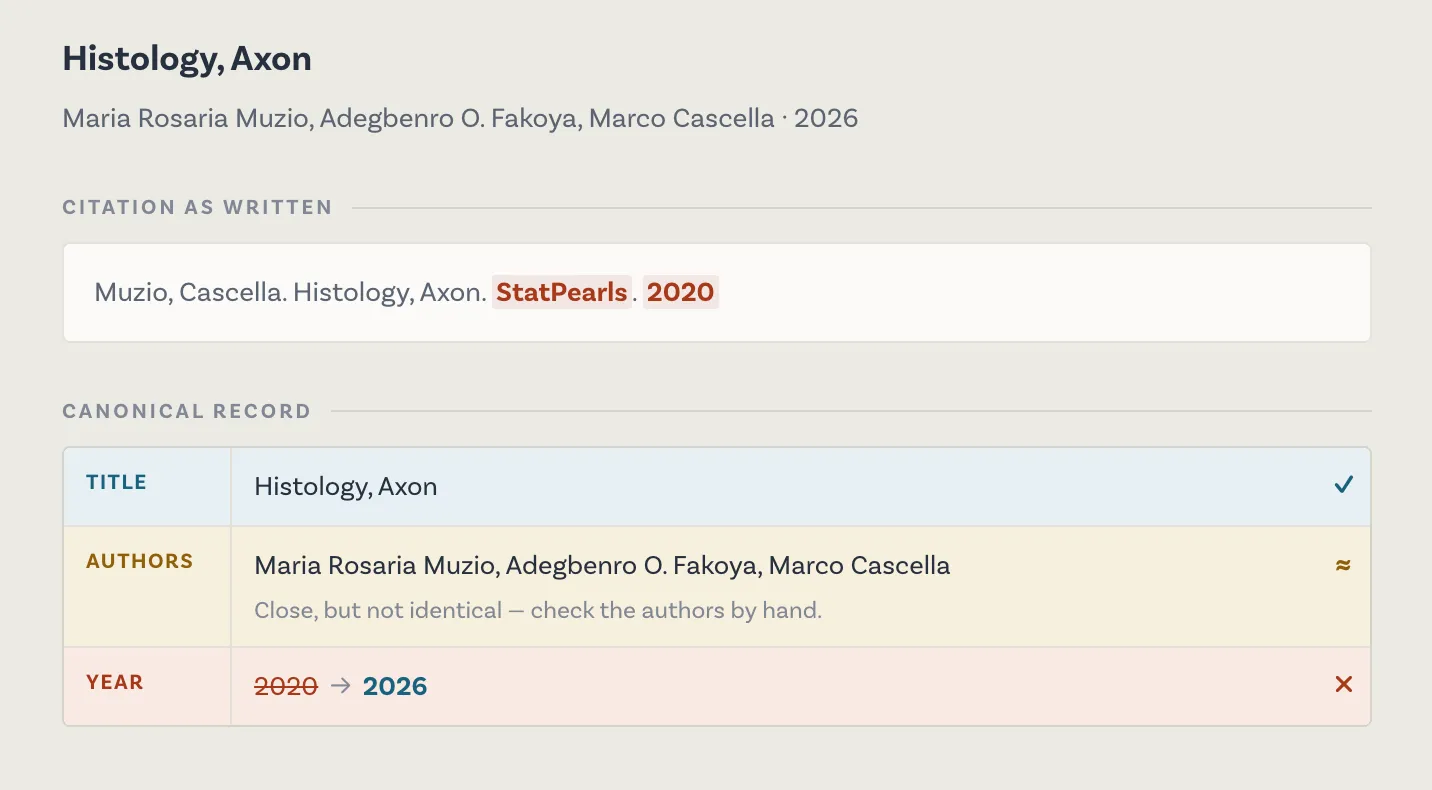
Why conventional tools miss this
Any tool that checks only whether a DOI resolves to a real paper will report all three citations as “verified.” Folio verifies the identity of the resolved paper against every field of the asserted citation — and flags the mismatch.
Paste a PMC ID and get a complete audit.
- 01
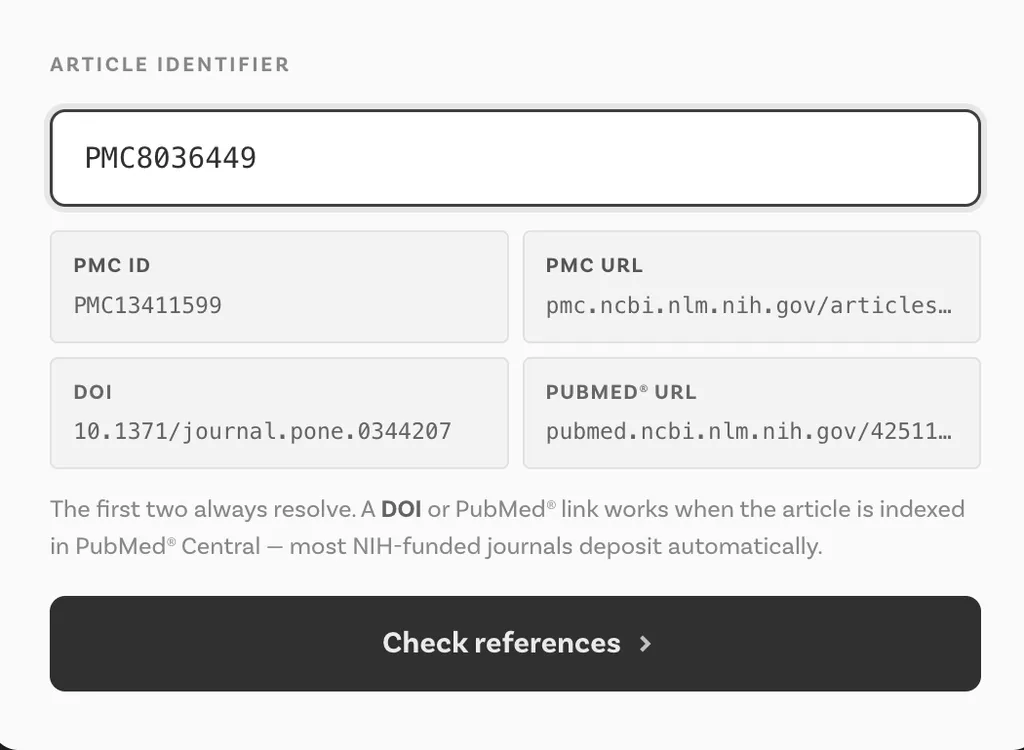
Enter any PubMed Central identifier.
Folio fetches the structured JATS XML record directly from NCBI — the authoritative source.
- 02
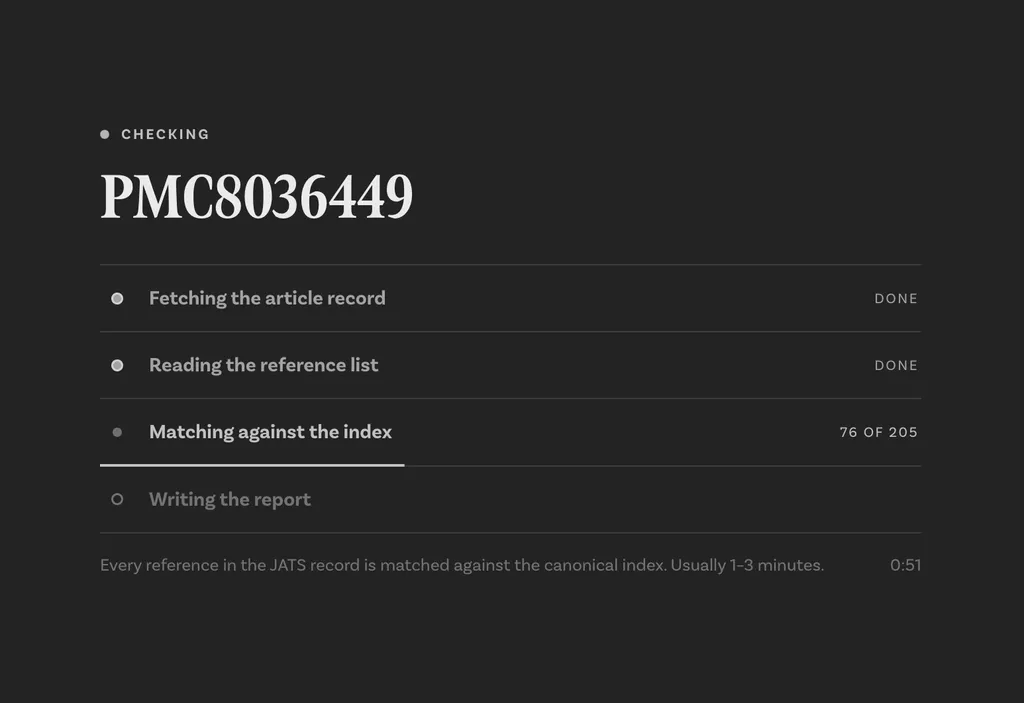
All references in the article are parsed from the XML.
No OCR. No PDF heuristics. Every field is captured exactly as it appears in the published record.
- 03
Each reference is matched against the Evidite database.
800 million canonical records from Crossref, PubMed, OpenAlex, and Semantic Scholar. Field by field, in parallel.
- 04
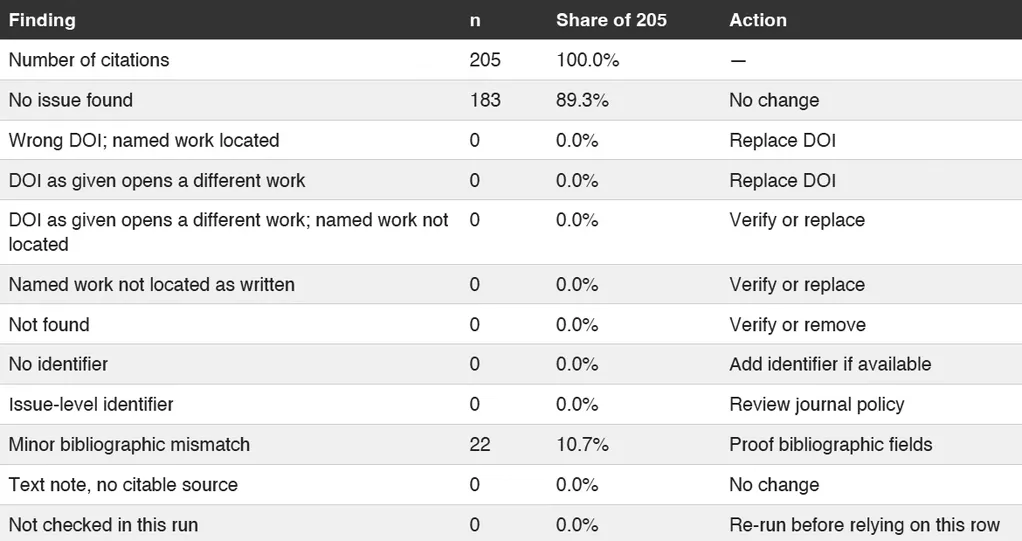
Every reference receives a verdict:
Verified, Partial Match, Unverified, or Type AI. Full field-level diff. CSV export with complete provenance.
For editors, authors or anyone accountable for the record.
Folio serves two different constituencies with the same tool and the same standard of evidence.
Journal editors
Run any published article through Folio before or after peer review. Identify reference errors that reviewers cannot catch. Build a systematic integrity standard into your editorial workflow.
- Paste a PMC ID — audit runs automatically
- Catch Type AI errors invisible to DOI existence checks
- Field-level discrepancy report for every flagged reference
- CSV export for editorial records and correspondence
- Enterprise integration for journal management systems
Article authors
Audit your own published paper before a correction becomes necessary. AI writing tools introduce errors that authors do not intend and cannot easily detect. Folio is the fastest way to know what you actually cited.
- Audit your article the day it goes live in PMC
- Verify that all DOIs resolve to the papers you intended to cite
- Identify field errors introduced by citation managers or AI tools
- Document your reference accuracy as a professional standard
- Free first audit — no subscription required to start