Patent Pending — Scientific Reference Verification
NO AI  •  Fully Deterministic  •  No False Positives

Screen Every Reference in Your Manuscript. Before It Reaches a Reviewer.

CitateScreen verifies every reference in a scientific manuscript or published article against more than 800 million canonical source records. Paste a PubMed Central ID or upload a Word document. Every reference is checked field by field — title, authors, journal, volume, year, pages. Discrepancies are flagged precisely. No AI touches the verification. Every result is traceable to its source.

Try CitateScreen SciPubAudit.org Enterprise Inquiry

800M+

Canonical Source Records

0

AI in the Verification Pipeline

2

Modes: Published Article & Manuscript

CitateScreen uses no artificial intelligence or machine learning. Every verdict is produced by deterministic comparison of canonical bibliographic records against independently reproducible rules. The same input always produces the same result.

No AI or ML
Fully Deterministic
No False Positives
Every Result Traceable

Paste a PMC ID. In under a minute, every reference has a verdict.

Fetched directly from the structured JATS XML record — not scraped, not parsed from PDF. Every field extracted from the authoritative source and checked against 800M+ canonical records.

PLoS ONE • Published Article
Amyotrophic Lateral Sclerosis and Frontotemporal Dementia: A Common Pathway to Neurodegeneration
Corbo M, Iannaccone S, Chiò A, Lazzerini A, Nobile-Orazio E, et al.
References (47)
1. Rosen DR, et al. Nature 1993;362:59–62
2. Neumann M, et al. Science 2006;314:130–133
3. DeJesus-Hernandez M, et al. Neuron 2011;72:245–256
4. Mackenzie IR, et al. Acta Neuropathol 2010;119:1–11
43 more…
Before
< 60 sec
CitateScreen • Evidite, Inc.
Reference Verification Report
PMC13411599 • PLoS ONE
47
Total
44
Verified
2
Partial
1
Unverified
Reference 3 of 47
Submitted: DeJesus-Hernandez M, et al. Neuron 2011;72:245–256
⚠ DISCREPANCY
Field mismatch detected
Field
As Written
Verified Record
Match
Pages
245–256
245–256
Volume
72
72
Year
2011
2011
Issue flagged: Page range in manuscript does not match canonical record. Verify against source.
Verification is deterministic — no AI was used in any step.
After

Reference Errors Are Accelerating. Peer Review Doesn’t Catch Them.

The fabrication of scientific references has increased more than tenfold in three years. Conventional peer review was never designed to catch them.

12× Increase

Rise in papers containing at least one fabricated reference, from 1 in 2,828 (2023) to 1 in 277 (2026).

Ponce-de-León et al., The Lancet (May 2026). Screening of 2.5 million biomedical papers.

110,000+

Publications with invalid AI-generated references identified in scientific literature in 2025.

Naddaf & Quill, “Hallucinated Citations Are Polluting the Scientific Literature,” Nature 652 (2026): 26–29.

1.23%

Unverified reference rate in post-2024 PNAS articles — 31% higher than the pre-2022 baseline of 0.94%.

Evidite PANDA Study (2026). 2,345 PNAS articles, 269,603 references screened.

Invisible to Review

Fabricated references are correctly formatted and attributed to real researchers. They routinely survive conventional peer review.

The only reliable detection method is deterministic comparison against canonical bibliographic records.

“Hallucinated citations are correctly formatted and attributed to real researchers—making them indistinguishable from legitimate references to the human eye.”

Naddaf & Quill, Nature 652 (2026)

Published Articles and Manuscripts. Both Fully Covered.

CitateScreen handles the complete lifecycle of a scientific paper — from manuscript draft to published record.

Published Article Mode

For articles already in PubMed Central.

  • Paste a PMC ID, DOI, or article URL
  • References fetched from structured JATS XML — no PDF parsing, no OCR
  • Every reference verified against 800M+ canonical records in parallel
  • Field-by-field comparison: title, authors, journal, volume, year, pages
  • CSV audit trail with full provenance
Try Published Article Mode

Manuscript Mode

For manuscripts not yet submitted or published.

  • Upload a Word (.docx) manuscript
  • All references and endnotes extracted automatically
  • Each reference resolved and verified in parallel
  • Field-level discrepancies flagged before submission
  • PDF report and CSV export included
Try Manuscript Mode

From Reference List to Verified Audit. Automatically.

Five steps from document input to structured verification report. No manual lookup. No AI.

1

Input

Paste a PMC ID, DOI, or article URL — or upload a Word manuscript. CitateScreen accepts both.

2

Extract

References are extracted from structured JATS XML (published articles) or parsed from Word endnotes (manuscripts). Every reference, every field.

3

Resolve

Each reference is resolved against 800M+ canonical source records spanning Crossref, PubMed, OpenAlex, Semantic Scholar, and Stacks.

4

Compare

Every field in the reference — title, authors, journal, volume, year, pages — is compared against the canonical record. Discrepancies are flagged precisely.

5

Report

A structured report is generated: per-reference cards with field comparison tables, a summary with verdict counts, and a full CSV audit trail.

Four Verdicts. No Ambiguity. No False Positives.

Every reference receives one of four verdicts. Each verdict is produced by deterministic comparison against canonical records — never by inference or probability.

VERIFIED

All checked fields match the canonical record. The reference is confirmed. No action required.

PARTIAL

A canonical record was found, but one or more fields (volume, year, pages) do not match. The specific discrepant fields are shown side by side. Review before submission.

UNVERIFIED

No matching canonical record found across all checked databases. The reference may not exist as cited, or may not yet be indexed. Verify against original source before submission.

TYPE A — DISCREPANCY

A canonical record was found at the given DOI or identifier, but key bibliographic fields differ from what was cited. The discrepancy is shown field by field. This is the most diagnostic finding — a real record with mismatched details.

The Opposite of AI-Generated References.

“AI generates references by prediction. We verify them by comparison. These are not the same operation, and they are not interchangeable.”
— Eric Caplan, Founder and CEO

Deterministic, Not Probabilistic

A language model predicts what a reference probably looks like based on training data. CitateScreen retrieves the canonical record from an authoritative source and compares field by field. There is no probability involved. Either the fields match or they don’t.

No False Positives

CitateScreen does not flag a reference unless a specific, articulable discrepancy exists between what was cited and what the canonical record shows. A verified reference is verified because the fields match — not because a classifier said so.

Every Result Reproducible

Submit the same reference list today and in six months. If the canonical record hasn’t changed, you get the same result. No hallucination. No drift. No version-to-version inconsistency.

CitateScreen vs. AI-Based Approaches

Capability AI Tools CitateScreen
No false positives
Reproducible results
Field-level discrepancy
Traceable to source
Whole-document audit
CSV audit trail

Comparison as of August 2026

What CitateScreen Actually Produces.

Every audit generates a Reference Position Map and a per-reference card for every discrepancy found. These are live outputs — not mockups.

Reference Position Map

Every reference in the document plotted as a colored cell. Green = Verified. Orange = Partial. Red = Unverified. Dark red = Type A discrepancy. Gray = text note (no citable source). At a glance, an editor sees the shape of the entire reference list.
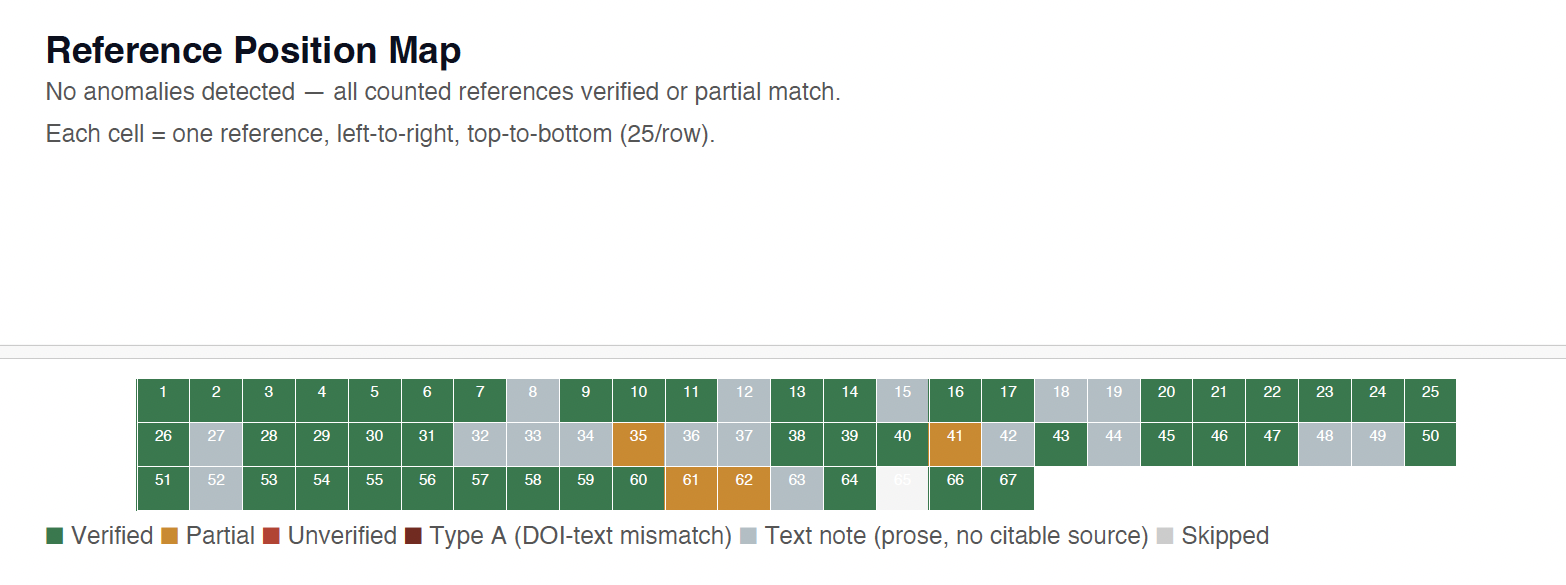
CitateScreen Reference Position Map showing 67 references color-coded by verification status

Per-Reference Verification Card

Every reference with a discrepancy gets a card. The citation as written is shown with incorrect tokens highlighted in red. The verified record shows each field — title, authors, journal, year — with a precise verdict: Accurate or Inaccurate. In this example, the manuscript listed “Thomas Grissly and Paul S. Appelbaum” as authors. The canonical record shows only Thomas Grisso. No AI inferred this. The comparison is deterministic, field by field.
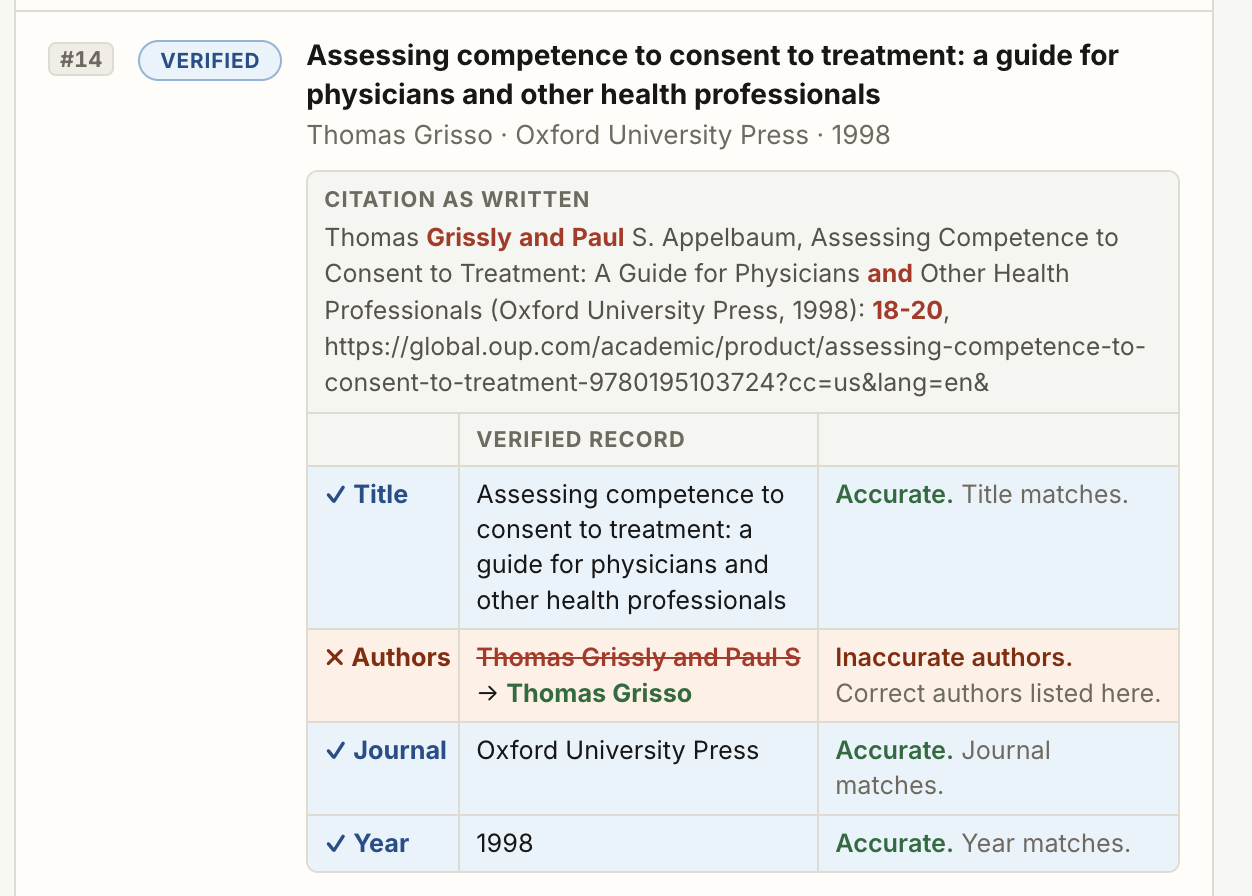
CitateScreen citation card showing field-level comparison: Authors field flagged as inaccurate — Thomas Grissly and Paul S. corrected to Thomas Grisso

For Everyone Whose Name Appears on a Reference List.

Citation errors damage reputations and corrupt the scientific record. CitateScreen makes systematic reference verification accessible to anyone who publishes.

Journal Editors

Screen every submitted manuscript before peer review begins. Flag unverified references and field discrepancies before they reach reviewers. Reduce post-publication corrections.

Authors

Verify your reference list before you submit. If you used AI writing tools, verify before you trust. Every discrepancy is shown field by field so you know exactly what to fix.

Peer Reviewers

Reference checking is not part of the peer review mandate — but CitateScreen makes it possible in seconds. Paste the PMC ID and review the audit before you submit your evaluation.

Research Integrity Officers

Run a systematic audit of any published article against the canonical record. CitateScreen produces a structured CSV that can be used as documentary evidence in an investigation.

A Verification Cache Built for Scale.

CitateScreen checks every reference against a proprietary index of more than 800 million canonical source records spanning all major scholarly databases. The most-cited publications resolve in milliseconds. Less-common references are verified against live authoritative sources.

Scholarly Coverage

Crossref, PubMed, OpenAlex, Semantic Scholar, and the Evidite Stacks index. Hundreds of millions of pre-cached article records across science, medicine, social science, and the humanities. Every field — title, authors, journal, volume, issue, pages, year — preserved from the canonical source.

JATS XML First

For published PMC articles, references are extracted from structured JATS XML — not from PDF text, not from HTML scraping. This eliminates the parsing ambiguity that plagues every PDF-based approach and ensures the reference list is complete and accurately structured before verification begins.

Every Reference Verified. Every Discrepancy Shown. No AI.

CitateScreen is available now at citatescreen.com (manuscript upload) and scipubaudit.org (published article by PMC ID or DOI). Both are free to use.

Try CitateScreen SciPubAudit.org Enterprise Inquiry Read Our Story