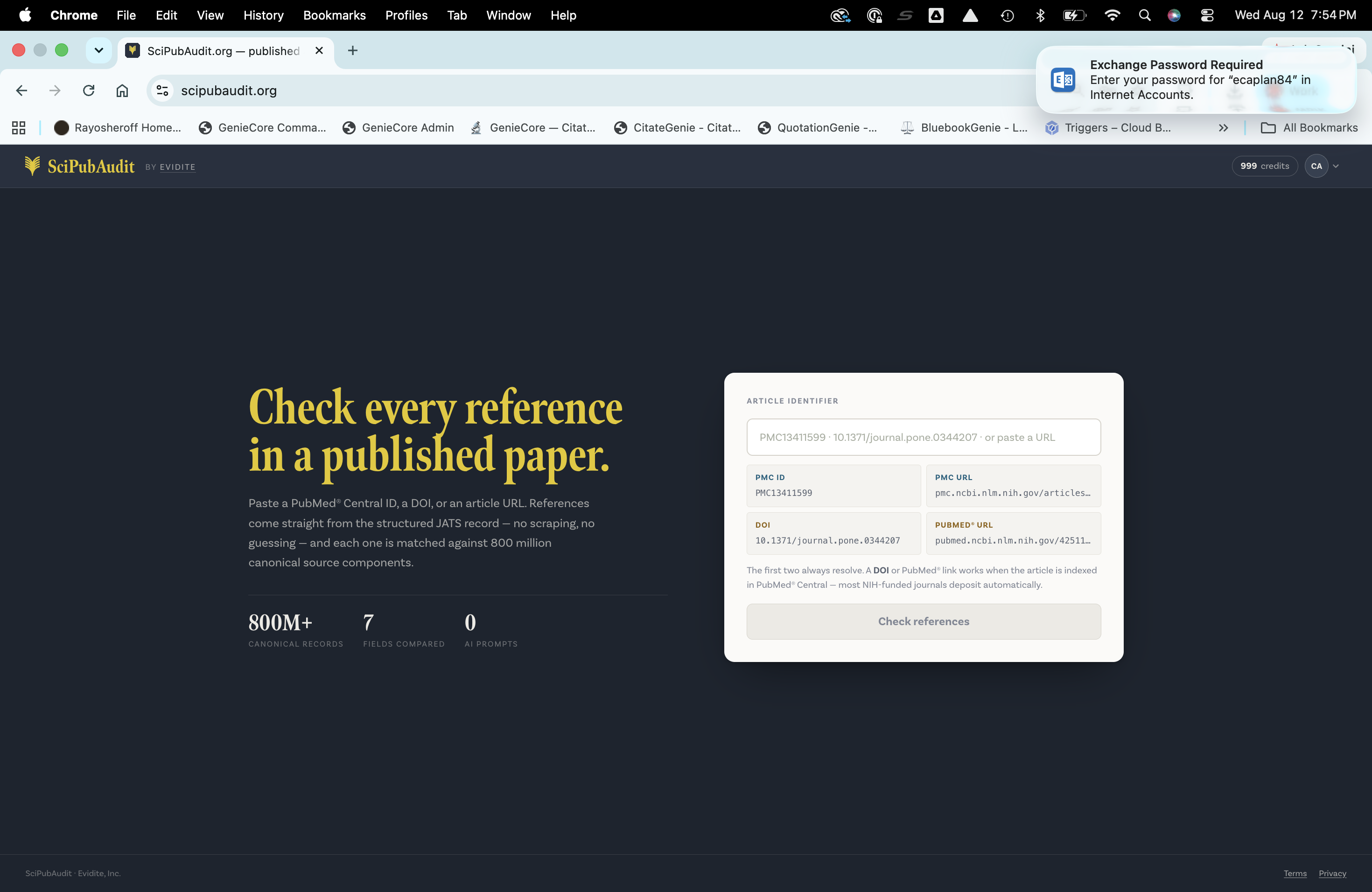
The interface
Paste a PMC ID. Get a complete audit.
Every reference is displayed with its verdict, field-by-field comparison, and source provenance. Export the full audit as CSV.
SciPubAudit verifies every reference in a published scientific article against more than 800 million canonical source records. Paste a PubMed Central ID. Every reference is checked field by field — title, authors, journal, volume, year, pages, DOI. The most dangerous error — Type AI, where a DOI resolves to a completely different paper — is caught automatically. No AI. Every result is traceable to its source.
Canonical Source Records
AI in the Verification Pipeline
Citation Error Types Detected
SciPubAudit uses no artificial intelligence or machine learning. Every verdict is produced by deterministic comparison of canonical bibliographic records against independently reproducible rules. The same input always produces the same output.
Fabricated and distorted citations now appear in journals across every discipline. They are correctly formatted, attributed to real researchers, and invisible to conventional peer review.
Rise in papers containing at least one fabricated reference — from 1 in 2,828 (2023) to 1 in 277 (2026).
Ponce-de-León et al., The Lancet (May 2026). 2.5 million biomedical papers screened.
Unverifiable references in AI-assisted papers relative to human-authored controls, across 56 journals in JAMA Network.
Topaz et al., JAMA Network Open (2026). Pre-/post-AI comparison across 56 journals.
Unverified reference rate in post-2024 PNAS articles — 31% higher than the pre-AI baseline of 0.94%.
Evidite PANDA Study (2026). 2,345 PNAS articles, 269,603 references. RR 1.31, p = 2.2×10⁻¹³.
Publications with invalid AI-generated references identified in the scientific literature in 2025 alone.
Naddaf & Quill, “Hallucinated Citations Are Polluting the Scientific Literature,” Nature 652 (2026): 26–29.
“Hallucinated citations are correctly formatted and attributed to real researchers—making them indistinguishable from legitimate references to the human eye.”
Naddaf & Quill, Nature 652 (2026)A Type AI error is the most dangerous citation failure: the identifier is technically valid, but the DOI resolves to a completely different scientific work. The asserted title, authors, and findings are attributed to a paper that says something else entirely. No existence-based tool catches it.
Real examples from a 2026 audit of PMC13415537 — a Nature Communications paper on ion-sieving membranes containing 5 Type AI errors (7.1% of 70 references). Each DOI resolves to a real paper on an unrelated topic.
Why conventional tools miss this: Any tool that checks only whether a DOI resolves to a real paper will report all three citations as “verified.” SciPubAudit verifies the identity of the resolved paper against every field of the asserted citation — and flags the mismatch.
Canonical source records in the Evidite Stacks database
Citation error types identified and classified
AI or machine learning in the verification pipeline
Typical audit time for a full published article
References are fetched from structured JATS XML — not scraped, not parsed from PDF. Every field is compared against canonical records in parallel. The verdict is reproducible and traceable.
Enter any PubMed Central identifier. SciPubAudit fetches the structured JATS XML record directly from NCBI — the authoritative source.
All references in the article are parsed from the XML. No OCR. No PDF heuristics. Every field is captured exactly as it appears in the published record.
Each reference is matched against the Evidite Stacks database — 800 million canonical records from Crossref, PubMed, OpenAlex, and Semantic Scholar. Field by field, in parallel.
Every reference receives a verdict: Verified, Partial Match, Unverified, or Type AI. Full field-level diff. CSV export with complete provenance.
Every reference is displayed with its verdict, field-by-field comparison, and source provenance. Export the full audit as CSV.
SciPubAudit serves two different constituencies with the same tool and the same standard of evidence.
Run any published article through SciPubAudit before or after peer review. Identify reference errors that reviewers cannot catch. Build a systematic integrity standard into your editorial workflow.
Audit your own published paper before a correction becomes necessary. AI writing tools introduce errors that authors do not intend and cannot easily detect. SciPubAudit is the fastest way to know what you actually cited.
Paste a PMC ID. No credit card. No setup. The first audit is free. If the results matter, you’ll know immediately.